A custom printed backpack should lock the base fabric, print method, repeat scale, panel priorities, color reference and permitted placement variation before cutting. Approve the actual printed production-intent fabric and a physical bag sample; a digital artwork file alone cannot control how motifs crop across pockets, curves and seams.
A custom printed backpack succeeds or fails before the first seam is sewn. The artwork has to fit the fabric, print process and cutting plan; otherwise a clean digital file becomes clipped motifs, mismatched pockets or a different color from one production lot to the next.
OEM buyers should treat an all-over print as a manufacturing specification, not a decoration added after the bag is designed. Lock the print method, repeat, panel priorities and color standard before the factory cuts the approved sample.
| Print approach | Best fit | Approval focus |
|---|---|---|
| Screen print | Limited spot colors and clear graphic shapes | Ink system, opacity, registration and hand feel |
| Heat transfer or sublimation | Detailed polyester artwork and repeat patterns | Base fabric, heat behavior, color and repeat scale |
| Digital textile print | Shorter development cycles and complex artwork | Fabric compatibility, color profile and rub performance |
| Printed coated surface | Fashion or wipe-clean programs | Adhesion, flexing, edge finish and surface consistency |
Choose the print method with the base fabric
The artwork alone should not dictate the process. Polyester is commonly selected for transfer or sublimation programs because the print system and fiber can be engineered together. Nylon, canvas and coated materials may need a different ink or transfer route. A process that looks good on a flat test swatch can change the hand feel, coating performance or seam behavior of the finished bag.
Ask the supplier to identify the exact base construction: fiber, denier or yarn, finished weight, weave, coating and color. Then approve the print on that material. If a factory quotes from “printed polyester” without naming the substrate and process, two samples may look similar while the production risk is completely different.
Turn artwork into a controlled repeat
For an all-over pattern, the artwork file should define the repeat tile, scale, orientation and color references. The buyer also needs to decide whether motif placement is random or controlled. Random placement uses material efficiently but every finished bag looks slightly different. Controlled placement creates a more deliberate face panel and costs more material and cutting attention.
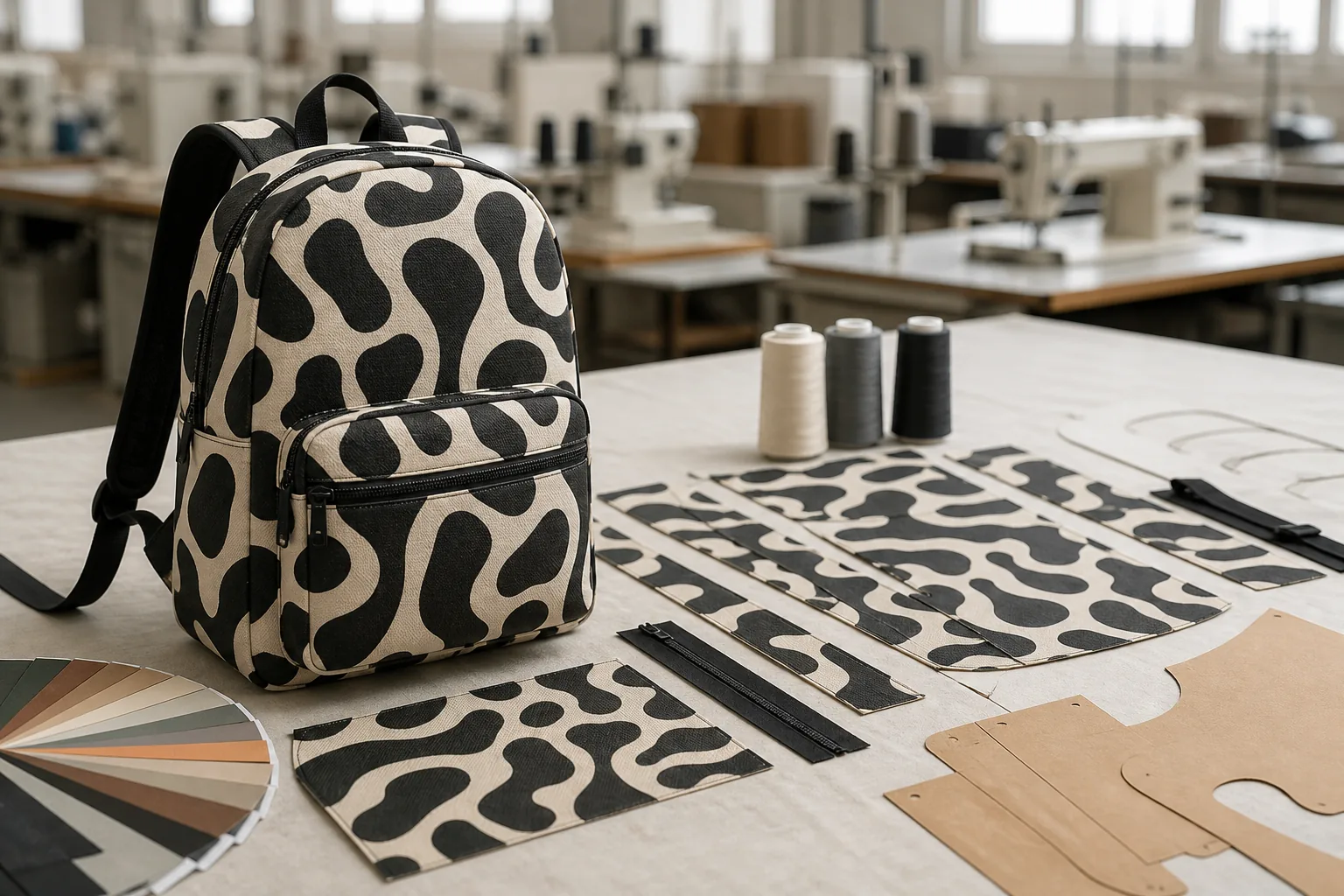
Mark priority zones in the tech pack: front panel, flap, pocket, side gusset and shoulder straps. If a motif must sit in a particular position, show its centerline and tolerance. If it can crop freely, say so. Our cow-pattern backpack is a useful physical reference for discussing repeat scale and panel coverage, while every buyer should supply original or properly licensed artwork for their own program.
Plan for seams, pockets and curved panels
A backpack is not a flat poster. Curved zipper panels, darts, piping and front pockets interrupt the artwork. The sample room should place pattern pieces over the repeat before cutting, then show how the design meets at visible seams. Perfect matching at every seam is often unnecessary and wasteful; controlled alignment at the most visible junctions is usually the better commercial decision.
Three questions prevent most surprises:
- Which panel carries the hero motif?
- Which seams require visual alignment?
- How much random variation is acceptable between units?
Record the answers in the approved sample comments. A buyer who expects every bag to look identical must approve a controlled placement plan and the resulting fabric yield, not discover that requirement at final inspection.
Control color with physical references
Screens display color differently, and printed color changes with fabric base, ink system, coating and lighting. Use a named physical color reference or an approved printed lab sample rather than relying on a phone screenshot. Evaluate the sample under consistent light and retain a signed swatch for bulk comparison.
The inspection plan should separate normal process variation from unacceptable drift. Check the main color family, important brand colors, visible banding, print registration and contamination. When an order includes multiple components or accessories, approve them together; black webbing, black zipper tape and printed black can look like three different colors even when each supplier calls them “black.”
Build durability checks around the use case
Printing does not replace construction. The sample still needs the correct seam allowance, binding, reinforcement, zipper and carrying system. For school and everyday programs, inspect the shoulder-strap anchors, handle, zipper corners and base. For coated or transferred surfaces, flex the material at seam folds and high-touch areas to see whether the finish changes.
Testing should match the product and destination market. The purchase specification can call for colorfastness, rubbing, adhesion, restricted-substance or other project-specific checks, but do not assume that a factory audit is a product test. Confirm the actual report scope and sample identity for the order.
Approve files, swatches and a physical sample
Elandmake's standard MOQ is 300 pieces per style and colorway. Sampling takes 3–7 days, with production in 15–30 days for light customization or 20–45 days for heavy customization. A new repeat, major pattern change, special substrate or new tooling may place the program in the heavy-customization range. Sample fees can be deducted from the bulk-order payment after order confirmation; the quotation confirms the amount and freight.
The approval pack should contain the final artwork, repeat dimensions, panel map, physical color reference, material specification, logo file, packing requirement and signed sample comments. Version the artwork clearly. A file called “final-v7-new” is not a production control.
Frequently Asked Questions
Which printing method is best for an all-over backpack pattern?
There is no single best method. The correct choice depends on the base fiber and finish, artwork detail, color requirements, quantity and intended use. Approve the chosen process on the exact production-intent fabric before approving the bag sample.
Can every printed backpack have identical motif placement?
Yes, but only when controlled placement is designed into the cutting plan. It increases material use and cutting attention, so buyers should reserve exact placement for the panels where consistency adds visible value.
What files should a buyer send for a printed backpack quote?
Send editable or high-resolution artwork, repeat size, orientation, color references, panel priorities, logo files, bag dimensions and the expected order quantity. The factory can then quote the print route and material yield against one defined specification.
To develop an original printed backpack range, send the artwork and reference construction through the Elandmake contact form.