Luxury woven leather should be audited at strip preparation, weave tension, edge finishing, reinforcement and final shape retention, not judged from a finished photo alone. Elandmake does not produce Intrecciato-style woven leather in-house, so buyers requiring that construction should qualify a specialist facility; buyers seeking only a woven visual direction can compare structured PU, vegan-leather or canvas alternatives.
If you source high-end leather goods, you already know woven leather sits at the top of the craft. The trouble is that most supplier pitches sell the look and skip the engineering underneath. Every year I watch B2B buyers make the same call: they chase a specific weave pattern without auditing whether the structure holds up. A woven bag that frays at the seams after three months of use costs you far more in returns than you saved on the quote.
A note on scope: Elandmake does not run Intrecciato-style woven leather construction in-house. This guide is written so you can audit the specialist mills that do. What we build instead is structured PU and vegan-leather handbags and canvas totes, so if the woven look is a styling preference rather than a hard requirement, a stocked platform like our vegan leather hobo tote or a structured top-handle handbag gets you to market faster and at a fraction of the unit cost.
Why Sourcing High-End Woven Bags is a Minefield for B2B Buyers
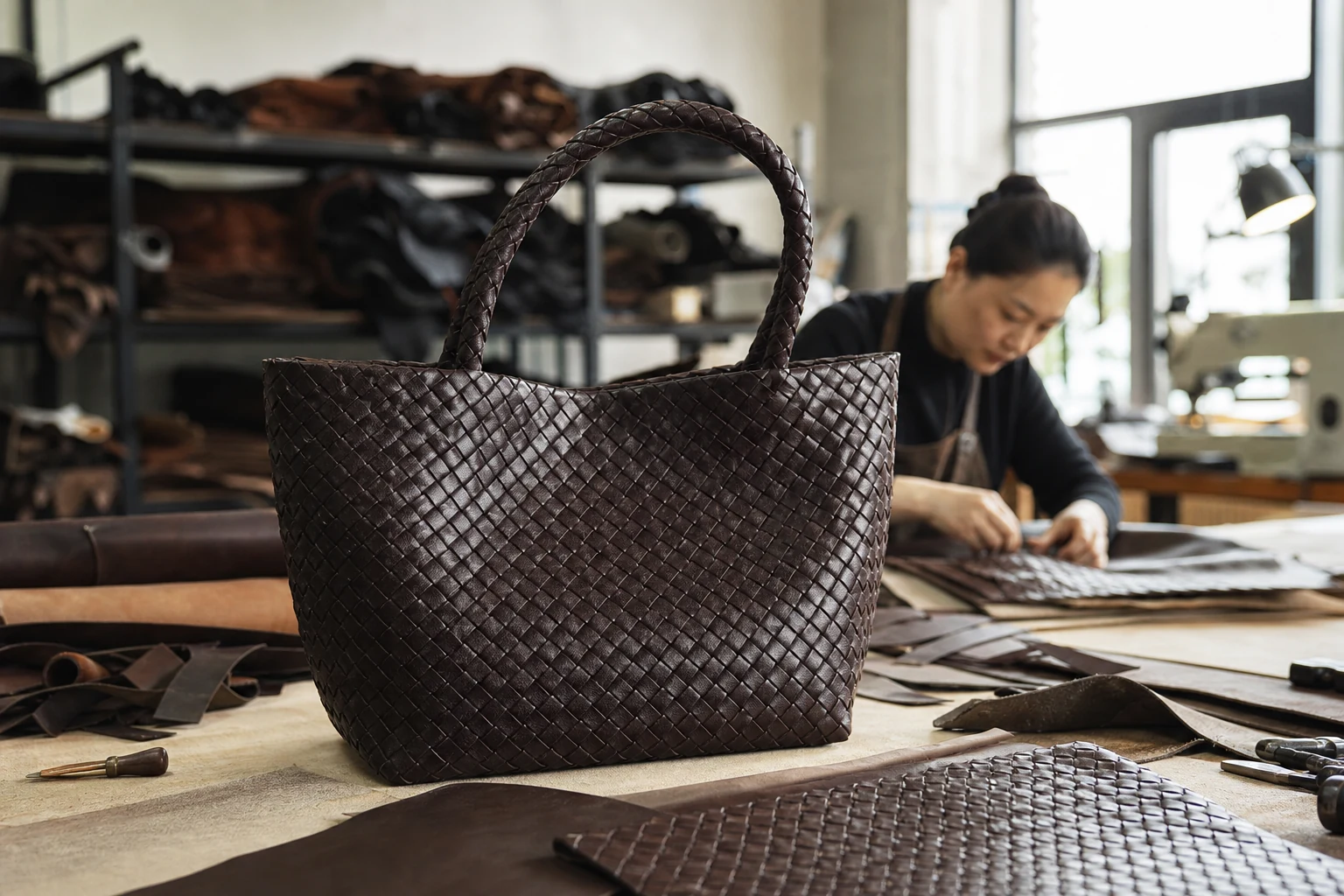
Plenty of procurement managers fall for the look of Bottega Veneta style Intrecciato weaving, then open a shipment where the leather strips (fettuccia) run uneven or the edge paint lifts within weeks. The gap between a premium woven bag and a cheap look-alike hides in the technical execution, not the photos.
Most complaints about high-end woven leather trace back to two things: poor edge finishing and low leather elasticity. When you buy woven leather, you are really buying the tension consistency of the weaver's hand. If that tension is off, the bag loses its shape the first time a customer drops a laptop or a heavy wallet inside. The same tension discipline decides whether a panel stays flat on any structured bag, which is why buyers often cross-shop this category against top-handle bag lines before committing.
Deconstructing the Craft: What Defines "Luxury Grade" Weaving?
To do this well, a factory has to move past basic hand-weaving. Three metrics that most buyers never see are what separate professional goods from street-market quality — put all three in your tech pack and make the supplier answer them in writing.
1. The Secret of the Fettuccia
It starts with the leather strips. A serious line cuts every strip on computerized hydraulic beds to hold a width of 1.0mm to 1.5mm with a tolerance of +/- 0.1mm. If the strips drift even slightly, the whole grid shifts and the pattern reads wrong. Ask for the cutting tolerance spec, not a photo of the finished weave.
2. Material Integrity: Beyond the Surface
The category only works in Full-Grain Nappa Lambskin or A-Grade Calf Leather. A lot of suppliers will offer you "genuine leather" here, but that is usually split leather under a heavy coating, and split leather cracks at the fold points of the weave. Drum-dyed Nappa runs consistent in color through the full cross-section of the hide, not just the surface — cut a sample strip in half and look at the edge.
3. The "Double-Faced" Standard
This is where real woven leather parts ways with the rest. Standard weaving leaves the raw, fuzzy underside of the leather showing on the bag's interior. The double-faced technique bonds two thin layers of leather back to back before weaving, so the inside looks as finished as the outside and needs no heavy fabric lining. If a quote is cheap and the interior is hidden behind a thick fabric lining, that is usually single-faced weaving covered up.
Cost Analysis: How to Balance Quality and Margin
Woven leather sits well above the mainstream bands, but the structure of a quote is the same everywhere; the custom bag manufacturing cost breakdown sets out how material, labour and order volume combine before you audit a specialist mill.
Knowing what the double-faced weaving technique actually costs matters for your 2026 budget planning. This is a labor-heavy process that cannot be fully automated, and the price reflects that.
| Component | Specification | Impact on Cost |
|---|---|---|
| Labor | 10+ Year Master Craftsman | High (1 bag can take 2-3 days) |
| Material | Full-Grain Nappa (1.2mm) | High (30-40% wastage rate) |
| Stitch Density | 9-11 stitches per inch | Moderate (Requires precision machines) |
| Edge Finish | 4-layer hand-painted oil | Moderate (Labor time) |
Leather wastage here runs well above standard bag production. Because long, continuous strips have to come from the prime center of the hide, the scrap rate can reach 40%. When a supplier quotes a woven bag at a price that looks too good, they are usually working with reconstituted leather or short strips joined by hidden seams.
Kevin's Factory Tip (The Pull Test): When you audit a sample, pull the weave on the diagonal. If the strips do not snap back into a clean grid, or you see permanent gaps, the leather was never pre-stretched. A proper process always includes a pre-tensioning phase so the weave does not sag over time.
When the Woven Look Is a Styling Choice, Not a Spec
Most of the private-label programs that come to us asking about woven leather do not actually need hand-woven Nappa. They need the visual language — soft drape, quiet luxury, no loud hardware — at a price and MOQ that works for a launch. That is a different build, and it is one we run ourselves:
- What we make : structured PU and vegan-leather handbags, quilted and chain styles, and canvas totes. For a quilted look on a chain strap, the closest stocked platform is our quilted chain shoulder bag.
- Compliance & Certification: the factory is amfori BSCI audited and ISO 9001 certified, with SGS testing and REACH reports available for EU and US programs.
- Invisible Branding : blind heat-embossing on interior patches and custom-mold zinc alloy hardware, so the branding stays subtle.
- Terms buyers ask for first : MOQ starts at 300 units per style and colorway, samples run 3-7 days, and bulk production lands in 15–30 days for light customization or 20–45 days for heavy customization. In-house QC inspects to AQL before anything ships, which keeps FBA and retail-compliance rejections down.
If a designer-inspired silhouette is what you are really after, the same tech pack review covers our Chanel style quilted bag options or a Celine style mini bag build.
There is no shortcut to quality in woven leather. You either pay a specialist for the skill upfront, or you pay for the returns and the brand damage later — and if the budget will not carry it, the honest move is to change the construction rather than cheapen the weave.
"I'm Kevin, founder of Jinhua Yilan Industry (Elandmake). We operate a 3,000 sqm BSCI-certified factory in Jinhua with 100+ production and technical staff. If you want straight talk and real factory prices, send me your tech pack for a free audit."