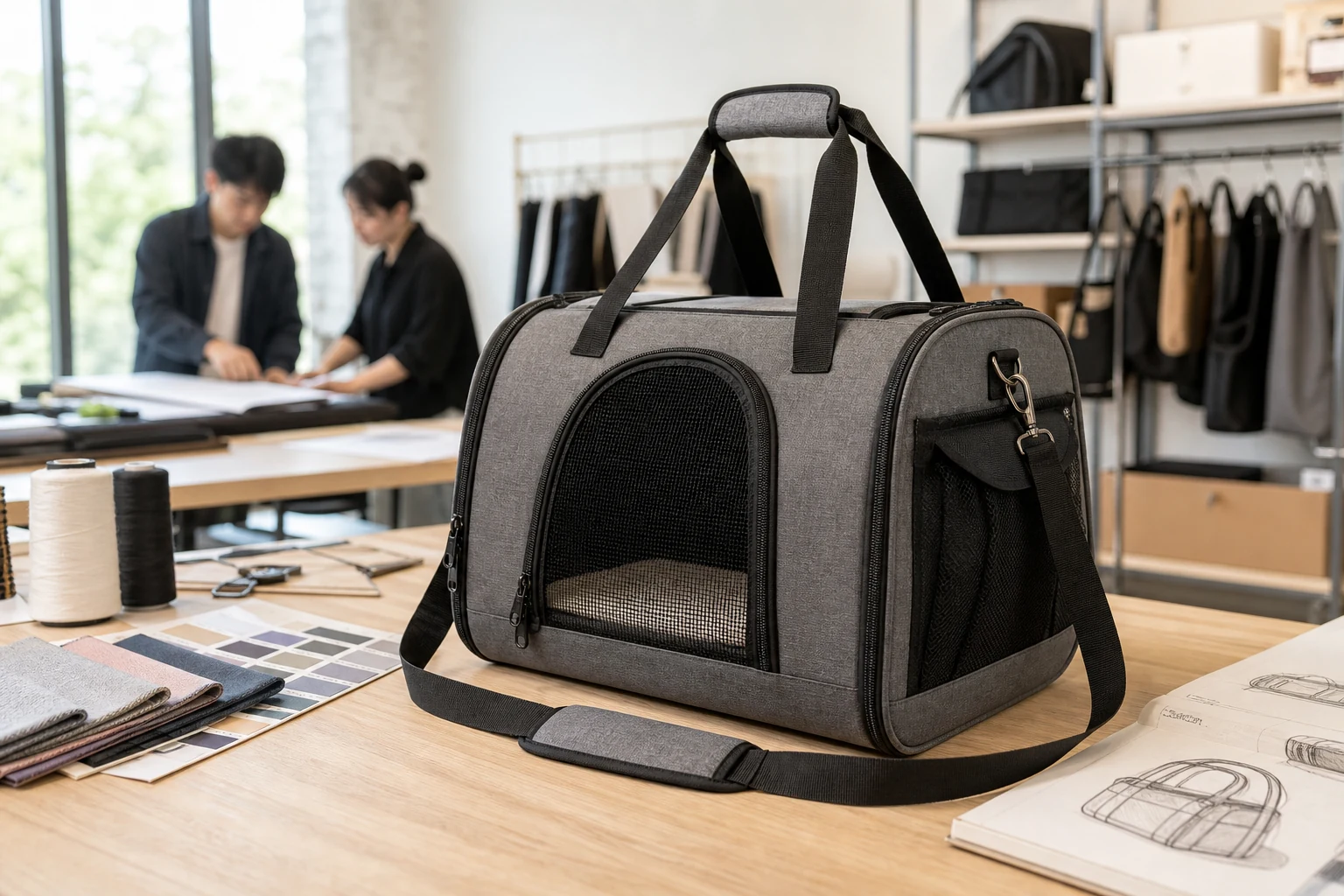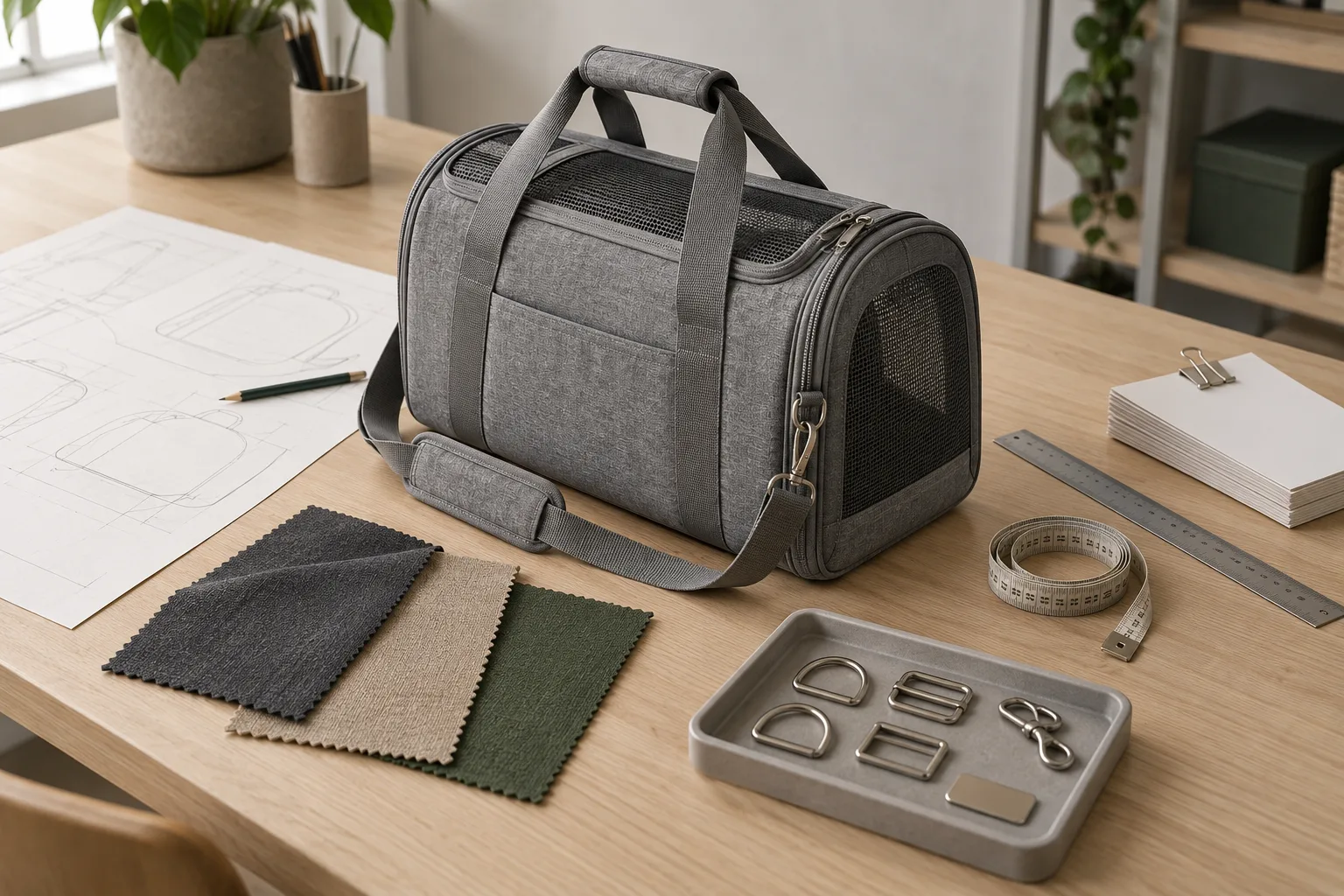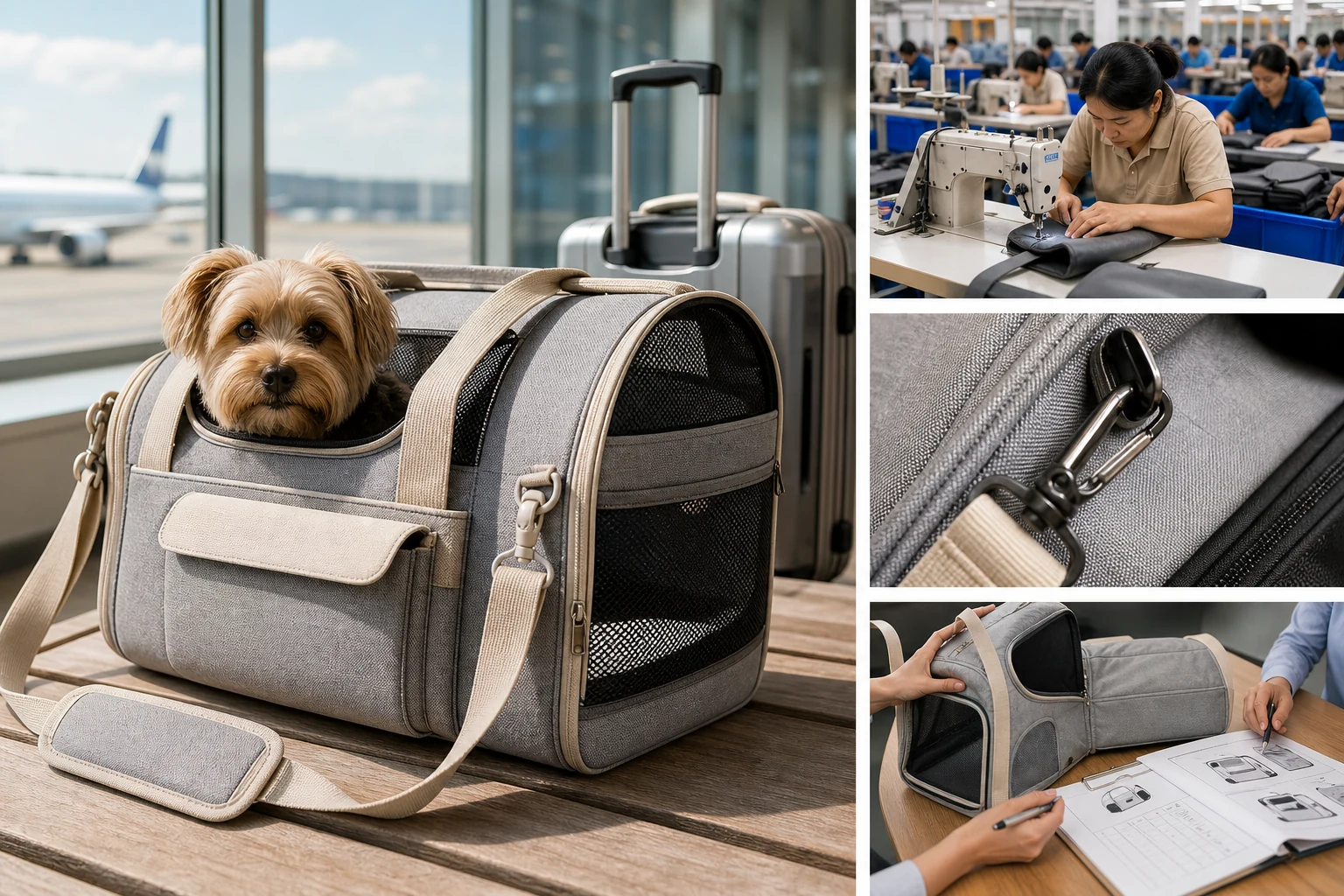
A private label dog travel organizer bag should be quoted as separate lines: the sewn bag at MOQ 300 pieces per style and colorway, the sourced accessory kit at each component's own minimum, and packing. Adjusting an existing pattern samples in 3-7 days with bulk production in 15-30 days; a new construction from a tech pack is heavy customization at 20-45 days with an engineering sample first. Sample fees can be deducted from the bulk-order payment after order confirmation.
A dog travel organizer bag is the product new pet brands ask us about more than any other: a weekender or road-trip bag with a dedicated food compartment, bowl and bottle pockets, a leash or waste-bag station, and usually an accessory kit sold alongside it. This guide covers the decisions a brand has to make before a factory can quote it properly, because "please quote a dog travel bag" produces a number that means nothing until the bag, the kit and the development route are separated.
For volume-first wholesale programs on standard builds, see our dog travel bag wholesale guide. This article is for brands developing their own product under their own label.
Separate the Bag From the Accessory Kit Before Asking for a Price
Most private label briefs we receive describe one retail item, but the factory sees two supply chains. The sewn bag is made on our own lines. The kit contents — collapsible silicone bowls, water bottles, treat containers, mats — are sourced parts with their own minimums, lead times and compliance paperwork. Quoting them as one line hides which part drives cost and which part drives the schedule.
| Component | Where it comes from | What sets the minimum | What to confirm before sampling |
|---|---|---|---|
| Sewn bag body | Elandmake production line | 300 pieces per style and colorway | Shell fabric, lining, zipper spec, base construction, logo method |
| Removable pouches / food container bag | Same line, often the same fabric roll | Counted with the bag when made in the same colorway | Whether it is a fixed part of the bag or a separately packed item |
| Collapsible bowl, bottle, treat box | Sourced from component suppliers | Each supplier's own minimum, quoted separately | Material declaration for the destination market, packing per unit |
| Retail packaging (box, hang tag, insert card) | Packaging supplier | Print minimum per artwork | Artwork files, box structure, whether the kit ships assembled |
Ask for the bag price and the kit price on separate lines, then a third line for assembly and packing if the kit ships as one retail unit. That structure lets you drop or swap a kit component without re-quoting the bag, which is the most common change between the first sample and the first order.
Choose the Development Route: Existing Pattern or New Build
Brands arrive with one of two positions, and each needs a different first step.
Route A — adjust an existing pattern. You want a proven bag body with your colors, your logo, a changed pocket layout or a different lining, and you want it fast. The factory starts from a pattern that has already been through production, so sampling is generally 3–7 days and bulk production is generally 15–30 days for light customization. The trade-off is that the silhouette and internal architecture stay close to the base pattern.
Route B — new construction from your tech pack or sketch. You have a concept the base patterns do not cover: a modular pouch system, a semi-rigid body, a fold-out mat, a docking interface. This is heavy customization: new pattern, possibly new tooling for hardware or a molded base, an engineering sample rather than a color sample, and bulk production generally 20–45 days after approval. Expect the first sample to be a validation sample, not a finished retail unit.
| Question | Route A: existing pattern | Route B: new build |
|---|---|---|
| What you send | Reference photos, color and logo files, requested changes | Tech pack or dimensioned sketch, target retail price, intended use |
| First sample | Existing pattern in your spec | Engineering sample; expect a revision round |
| Sampling window | Generally 3–7 days | Longer; confirmed per project after the tech pack review |
| Bulk lead time | Generally 15–30 days for light customization or 20–45 days for heavy customization | Generally 20–45 days |
| Minimum | 300 pieces per style and colorway | 300 pieces per style and colorway; structural tooling minimums are quoted separately |
| Where cost moves | Fabric grade, hardware, packaging | Pattern work, tooling, component count, assembly time |
If you are not sure which route you are on, send the reference and the sketch together and ask the factory to state plainly whether your concept is a Route A change or a Route B build. A factory that quotes a stock bag with your logo when you asked for a new structure has not answered the question. For the broader distinction, see OEM vs ODM bag manufacturing.
Write the Bag Specification the Factory Can Actually Price
Whichever route you choose, the quotation is only as good as the specification behind it. The items below are the ones that most often arrive missing from dog travel organizer briefs.
- Shell fabric by construction, not adjective. "Premium water-resistant textile" cannot be priced. "600D polyester, PU coated" or "900D Oxford, TPU backing" can. If you do not know, name the reference product you want it to feel like and let the factory propose two options with swatches.
- Compartment list with dimensions. Food compartment volume, bottle sleeve diameter, whether the bowl pocket is external or internal, and which pockets need a wipe-clean lining.
- Lining language. Ask for "water-repellent, wipe-clean" unless you are specifying a welded waterproof liner. The two are built differently and cost differently, and the wrong word ends up on your product page.
- Zipper and hardware references. Brand and gauge for the main zipper, and whether pull tabs, D-rings and buckles are standard stock, plated to a color, or custom tooled with your logo.
- Base construction. Soft, semi-rigid with an insert, or a molded base. This is the single biggest driver of whether you are on Route A or Route B.
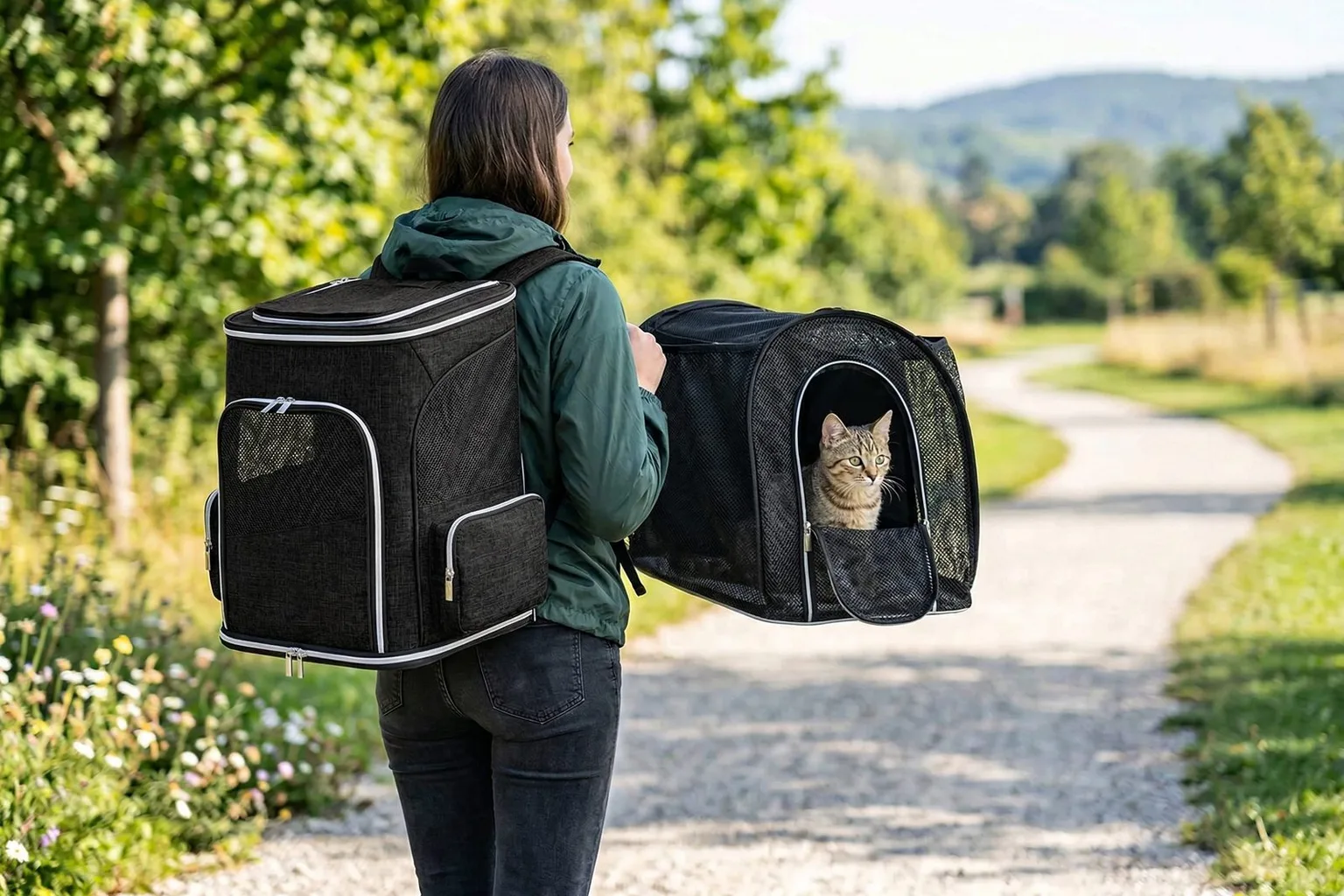
- Carry system. Handles only, removable shoulder strap, luggage sleeve, or crossbody wear for walking use. Our outdoor pet bag and pet travel backpack pages show the carry configurations we already produce, and the dog treat pouch is the base pattern most brands adapt for the walking-kit component.
- Branding by method. Woven label, embroidered logo, printed panel, metal badge. Each has a different setup and a different minimum, and a metal badge is a tooling item quoted outside the unit price.
Plan Samples, Minimums and Approvals Around Your First Run
At Elandmake the standard MOQ is 300 pieces per style and colorway. Sampling is generally 3–7 days for an existing pattern. Light customization production is generally 15–30 days; heavy customization such as new structure, new tooling or full new-product development is generally 20–45 days. These are planning figures; the confirmed schedule depends on the approved construction and is stated in the quotation.
Sample fees can be deducted from the bulk-order payment after order confirmation. The applicable amount and freight are confirmed in the quotation. If you need the sample approved by a partner before you can commit, say so up front so the sample terms are written for that sequence. Our sampling process guide walks through what happens between the brief and an approved sample.
Three planning habits save the most time on organizer projects:
- Approve the structural sketch before paying for a sample. For Route B builds, ask for a dimensioned drawing and a component list first. Revising a drawing costs a day; revising a sewn sample costs a week.
- Fix the colorway count before the quotation. MOQ applies per style and colorway. A three-color launch at 300 pieces each is a 900-piece program; if that is too large for a first run, launch in one or two colors and add the third on the reorder. See what MOQ means in bag manufacturing.
- Ask for packing data with the price. Pieces per carton, carton dimensions and gross weight tell you the freight cost per unit, which for a bulky organizer bag can change the landed cost more than the fabric choice does.
Send a Complete Private Label Brief
One consolidated brief gets you a usable quotation in the first reply rather than the third:
- intended use and target market, and whether the bag ships alone or with a kit;
- reference photos or tech pack, with the changes you want marked;
- fabric, lining, zipper and hardware references, or the reference product to match;
- compartment list with dimensions and the accessory items to be sourced;
- logo method, label and packaging requirements;
- quantity by style and colorway, and the date you need goods to leave the factory; and
- the documentation your destination market requires, so it is scoped before sampling.
Developing a dog travel organizer or weekender bag under your own brand? Contact Elandmake with your reference images or tech pack, target quantity and market. We will tell you which development route your concept falls under and quote the bag, the kit and the packaging as separate lines.
Frequently Asked Questions
Can I order fewer than 300 pieces for a first run?
The standard minimum is 300 pieces per style and colorway. A smaller first run is a project-specific decision that depends on the construction and is confirmed in the quotation, not a standing offer. Brands that want a small launch usually reduce the colorway count rather than the pieces per colorway.
Do you source the bowls, bottles and treat containers for the kit?
Yes, sourced kit components can be supplied and packed with the bag. They are quoted on separate lines because each component supplier has its own minimum, lead time and material documentation. You can also supply your own kit items for packing.
Is the sample fee refunded?
Sample fees are not refunded. They can be deducted from the bulk-order payment after order confirmation, with the applicable amount and freight confirmed in the quotation.
Will you change my design without telling me?
No. Construction changes proposed for manufacturability are put to you in writing for approval before the sample is made. Your approved drawing and component list are the reference for the sample and for bulk inspection.