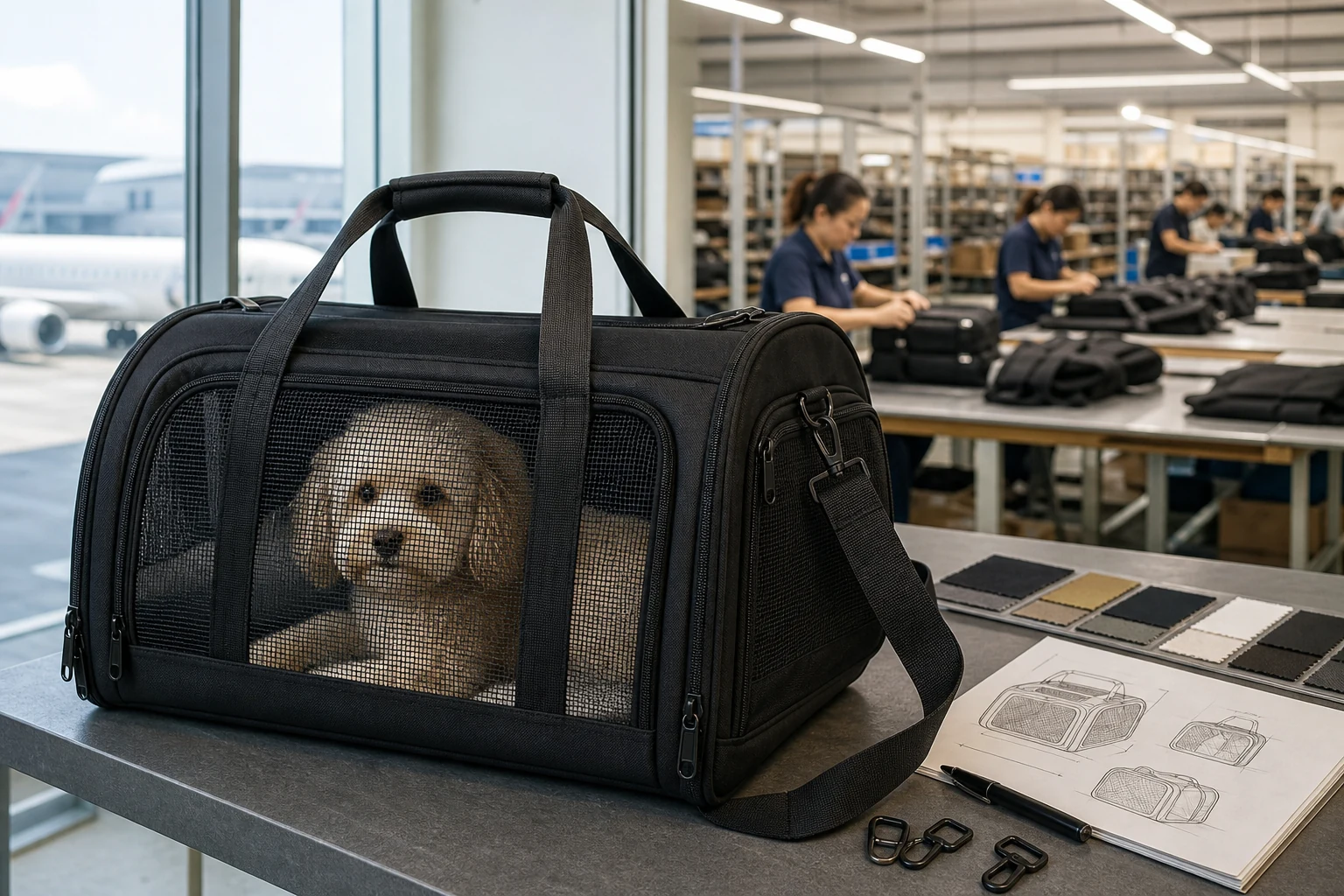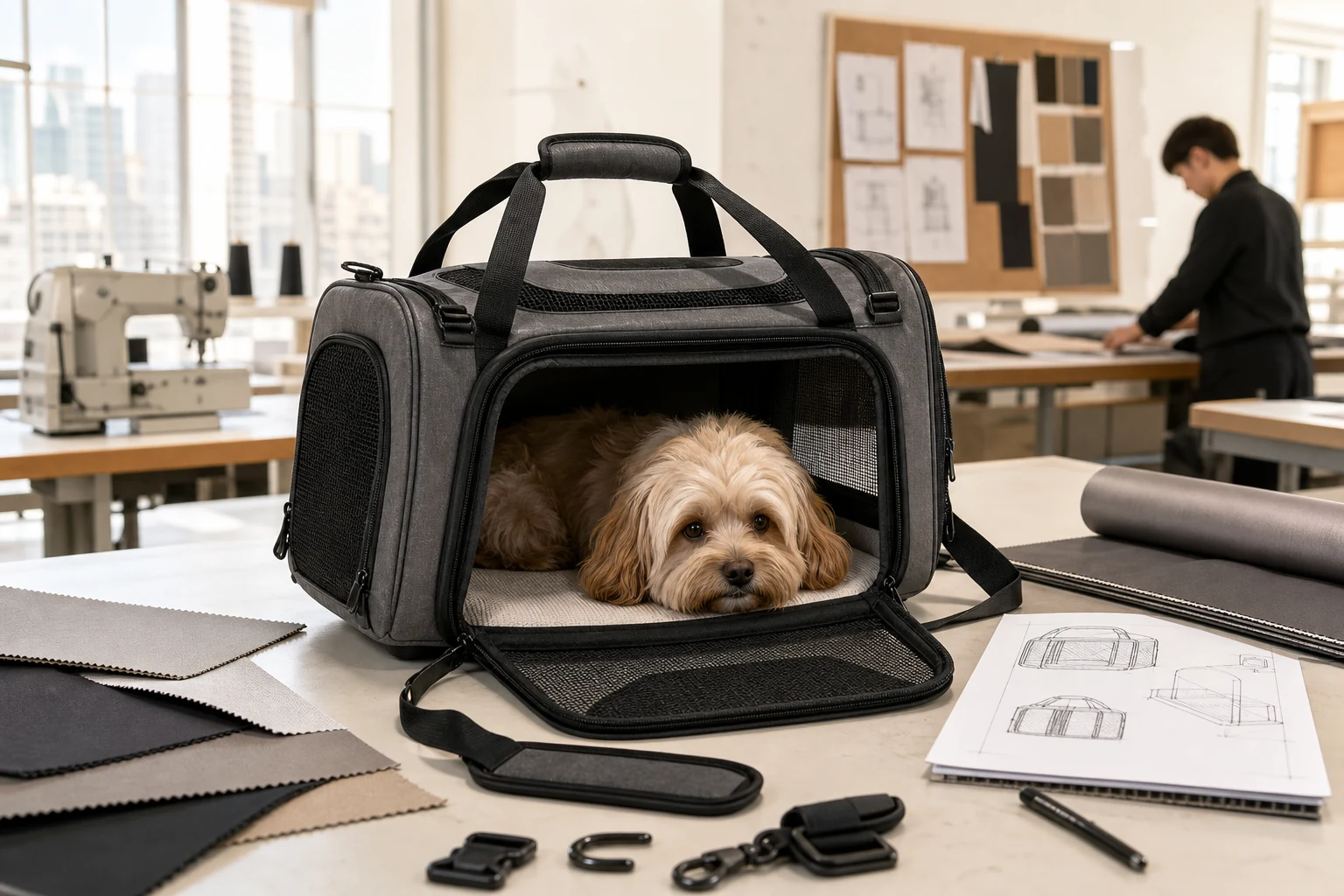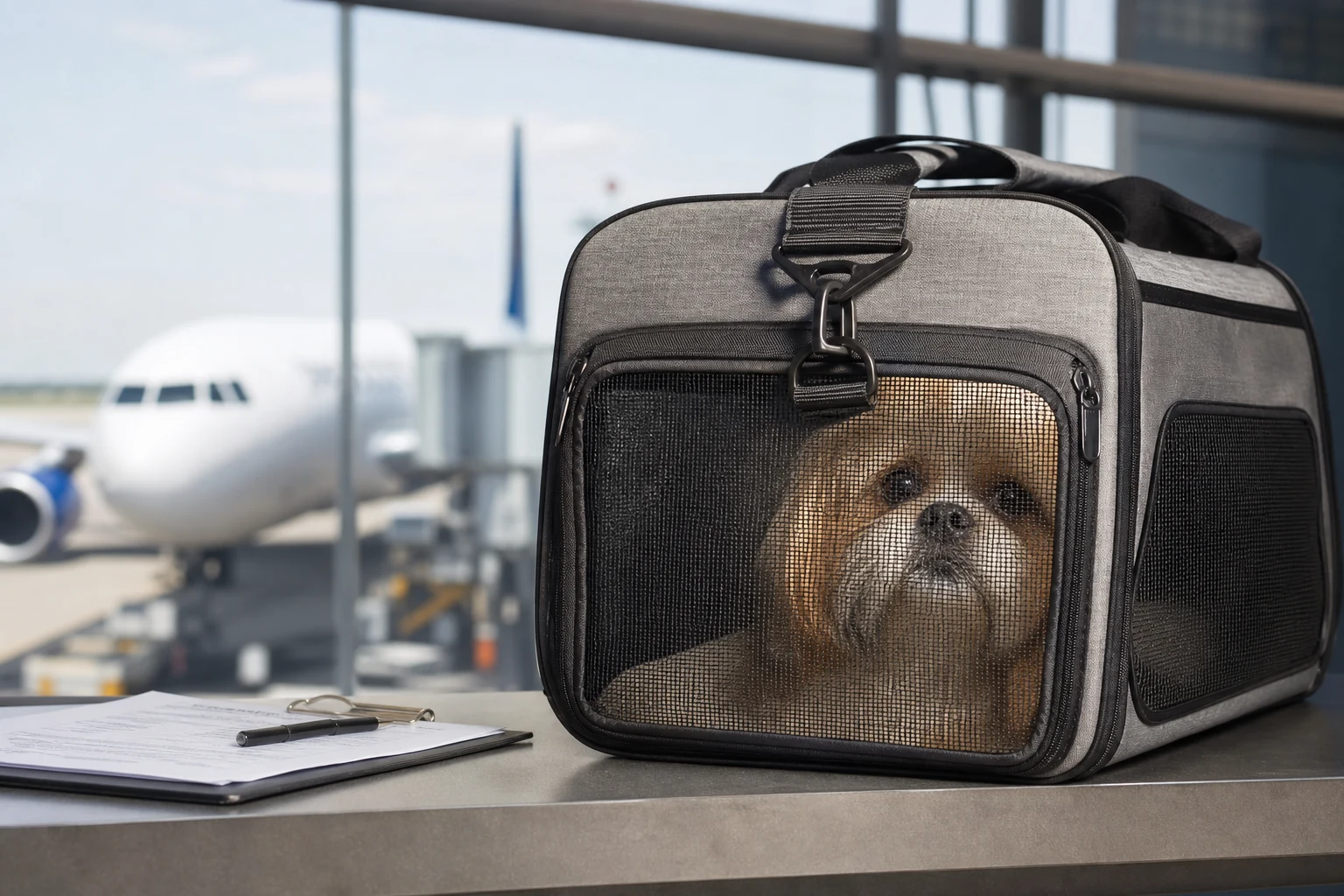
The 52nd edition of the IATA Live Animals Regulations took effect on January 1, 2026, and domestic cat and dog programs should use the current Container Requirement 1 plus state and operator variations. IATA does not publish one universal 45 x 35 x 20 cm cabin maximum and does not certify any carrier brand or model, so the buyer must confirm the animal, route and airline-specific limits before approving production.
For pet brand owners and wholesale buyers selling into the airline-travel segment, IATA airline pet carrier requirements belong in the product brief, but they are not a product certificate. A design has to be checked against the current IATA Live Animals Regulations, the animal, the route, and the operating airline's own rules. This guide separates those layers so an OEM buyer can write a testable specification without making a blanket "IATA approved" claim.
2026 Update: LAR 52nd Edition and Container Requirement 1
The 52nd edition of the IATA Live Animals Regulations took effect on January 1, 2026. For domestic cats and dogs, buyers should work from the current Container Requirement 1 (CR1), including its state and operator variations. IATA's 2026 changes clarify CR1 ventilation requirements and absorbent bedding.
IATA also states that it does not certify, approve, endorse, or sell any particular pet-container manufacturer, brand, make, or model. A supplier may manufacture a carrier against CR1 and a named airline specification, but neither the supplier nor the buyer should present the finished SKU as "IATA certified."
| Decision | What the 2026 brief must record |
|---|---|
| Applicable rule set | CR1 version, destination/state variations, operating airline, cabin or hold, and travel date |
| Size | Animal measurements and the airline's current under-seat or hold limits; IATA does not publish one universal 45 × 35 × 20 cm cabin maximum |
| Construction | Rigid or soft-sided route, smooth and escape-resistant interior, secure closures, and openings sized so they are nose- and paw-proof |
| Ventilation | CR1 ventilation layout plus airline-specific restrictions; labels, pockets, bedding, and under-seat compression must not block openings |
| Acceptance | Final acceptance belongs to the airline/check-in process, so recheck the named airline before production approval and again before travel |
For in-cabin travel, CR1 permits construction differences such as soft-sided or cloth bags, but the carrier still has to meet the applicable safety, ventilation, labeling, and airline acceptance requirements. The IATA Traveler's Pet Corner should be checked alongside the target airline's current policy.
July 2026 Update: IATA Operational Guidelines for In-Cabin Pet Transport
On 15 July 2026 IATA released Edition 1 of the Operational Guidelines for In-Cabin Pet Transport, announced in the IATA press release. It is operational guidance written for airlines, structured around the passenger journey from booking to disembarkation, and each section ends with recommendations to the airline rather than a mandatory rule. It does not replace CR1; it tells airlines how to apply CR1 and their own policy consistently.
Four points in the document matter directly to a carrier specification:
| Guideline statement (Edition 1, July 2026) | What it means for the OEM brief |
|---|---|
| Gate agents should verify that "both soft and rigid cabin containers comply with IATA LAR CR1 and airline-specific standards" and are "secure, well-ventilated, appropriately sized, and capable of fitting entirely under the seat in front of the passenger, where under-seat stowage is permitted, without compromising space and ventilation" | Soft-sided carriers are explicitly in scope. The brief must define the compressed under-seat dimension and prove ventilation is not blocked in that position, not only the free-standing size |
| The container must allow the pet "to stand, to sit erect, to lie in a natural position and to turn about normally while standing" | Usable internal height and length are checked against the declared animal, so the specification needs an animal size range, not only external dimensions |
| Passengers are responsible for "keeping the pet inside the container at all times, and ensuring the container is stowed during taxi, takeoff, landing, and turbulence" | Closures have to stay secure for the whole flight; a carrier that relies on the owner holding it shut does not meet the intent |
| Airlines should train cabin crew "on accepted container dimensions, under-seat space across their aircraft fleet" and inform passengers "of under-seat limitations across aircraft types" | Dimension limits remain airline- and aircraft-specific. There is still no single IATA cabin size, and a product cannot be marketed as fitting every aircraft |
The guidelines also note that eligibility is "subject to airline policy" and that destination rules may add breed restrictions and limits on the number of pets per traveler. None of this creates an "IATA certified carrier": IATA does not certify or approve containers, and acceptance at the gate stays with the airline. Buyers who receive a request for "IATA certification" from a distributor should answer with the CR1 checklist, the named airline's published limits and the sample test record, which is what our airline-approved pet carrier program is built to document.
Turn CR1 Into an OEM Specification
Start with the animal and route, not a catalog size. Record the animal measurements required by CR1, then confirm whether the carrier travels in cabin, as accompanied baggage, or in the hold. Build a route matrix if the SKU is marketed for more than one airline.
For a soft-sided airline carrier, specify the finished external dimensions under the airline's stated measurement method, the usable internal space, closure security, leak-resistant base, absorbent bedding allowance, ventilation layout, and what happens when the bag is compressed under a seat. Our mesh ventilation guide explains how to turn airflow and escape resistance into sample checks without inventing an "IATA-certified mesh" claim.
Key Factors to Consider When Sourcing IATA-Aligned Carriers
For B2B buyers commissioning custom airline-approved pet carriers, these are the specification decisions that matter most:
- Dimensional engineering from the start — don't finalize the aesthetics and then try to compress the dimensions. Work backward from the maximum allowed size and optimize interior volume within that constraint.
- Zipper specification — standard nylon coil zippers are not enough for airline-grade carriers. Specify YKK #5 or #8 metal teeth zippers with an auto-lock slider. This meets airline scrutiny and cuts return rates.
- Base board design — a removable PE foam board (density 30–40 kg/m³) gives the rigidity airlines expect while allowing flat-pack shipping that reduces volumetric weight costs.
- Ventilation mesh spec — define opening size, usable open area, tear resistance, attachment method, and how pockets or under-seat compression affect airflow; no mesh denier alone guarantees airline acceptance.
- Seam reinforcement — bar-tacked stress points at all corners and strap attachment points prevent the most common failure modes under load.
Industry Standards & Compliance: Beyond IATA
IATA sets the baseline, but buyers shipping to North America should plan for additional compliance layers:
US airline-specific rules
Major US airlines each publish their own carrier dimension and material requirements, and these sometimes differ from IATA guidelines. Some, for example, require a soft-sided carrier with a waterproof bottom liner. Cross-reference your target airline's current pet policy before you lock specifications.
California Prop 65
For products sold in California, evaluate zipper coatings, fabric dyes, foam, and other components against the buyer's current Proposition 65 plan. A factory audit is not proof that a particular material or finished carrier meets a chemical requirement; request project-specific declarations or test reports where the importer or retailer requires them.
CPSC safety standards
The Consumer Product Safety Commission doesn't publish pet-carrier-specific standards, but carriers with small parts or sharp edges accessible to humans (especially children) can draw scrutiny under general CPSC guidelines.
Material & Quality Breakdown for Airline-Compliant Carriers
Material choice carries extra weight on airline carriers because both the animal's safety and the product's ability to pass visual inspection depend on visible quality.
Outer fabric: 600D Oxford nylon or 1680D ballistic nylon give the density that reads as airline-grade while staying lightweight. Avoid 300D polyester here; it looks and feels too flimsy to inspire confidence.
Mesh panels: Specify the mesh by construction, opening size, tear and seam performance, and usable ventilation area rather than treating a denier number as a pass/fail rule. A double-layer mesh can improve escape resistance, but the layers must not reduce airflow below the applicable CR1 and airline requirements. Our custom mesh pet carrier is a starting construction, not evidence of route acceptance.
Base board: Removable PE foam board, 4–6mm thickness. Design it to fold or disassemble for flat-pack shipping efficiency, which can cut shipping volumetric weight by up to 60%.
Zipper: YKK #5 metal teeth with auto-lock slider is the category standard. For premium positioning, some brands specify YKK Excella or an SBS equivalent with a secondary locking mechanism.
Shoulder strap: Padded, adjustable, minimum 38mm width for ergonomic load distribution. D-ring connections should be riveted, not just sewn, to hold up under dynamic load.
Common Mistakes Buyers Make When Ordering Airline-Compliant Carriers
After producing airline carriers for brands across North America, these are the specification errors we see most often:
Mistake 1: Not testing the actual under-seat fit
Dimension specs on paper don't account for the real-world variability of aircraft seat configurations. Request a pre-production prototype and physically test it under an economy-class aircraft seat before approving bulk production.
Mistake 2: Over-compressing internal volume
First-time buyers often shrink carrier dimensions as far inside IATA limits as they can, then field complaints that the carrier is too small for real cats or small dogs. Leave realistic headroom — 2–3 cm on each internal dimension — and test with an actual animal of the target weight class.
Mistake 3: Specifying insufficient zipper quality
The zipper is the single most-returned component in pet carriers. Upgrading from a standard nylon coil zipper to a YKK metal teeth zipper adds roughly $0.20–0.40 to the unit cost and sharply reduces return rates. It's worth it every time.
Mistake 4: Ignoring airline-specific variation
Sourcing for "airline-approved" as a blanket category, without naming the specific airlines you're targeting, opens you up to listing disputes on major marketplaces when a customer finds the carrier doesn't fit their airline's rules.
Finding the Right OEM Manufacturing Partner for Airline Carriers
Not every bag factory can reliably translate CR1 and airline variations into a controlled sample. Look for these capabilities when evaluating a travel pet carrier manufacturer:
- Documented experience developing carriers against named airline and route requirements
- In-house 3D CAD capability to model and verify dimensions before physical samples
- Material testing certificates for mesh, zippers, and base board materials
- BSCI documentation for the manufacturing site's social-compliance audit; evaluate quality controls separately
- Willingness to provide reference samples and a written compliance matrix without claiming IATA product certification
At Elandmake, we develop airline-approved pet carriers against the buyer's named airline and route requirements starting from MOQ 300 pieces per style and colorway, with 3–7 day sampling and bulk production of 15–30 days for light customization or 20–45 days for heavy customization. The buyer and airline retain responsibility for confirming the current rules and final acceptance.
Ready to source a pet carrier for a defined airline program? Send the route, airline, animal range, target dimensions, and documentation requirements with your RFQ. → Request a Quote