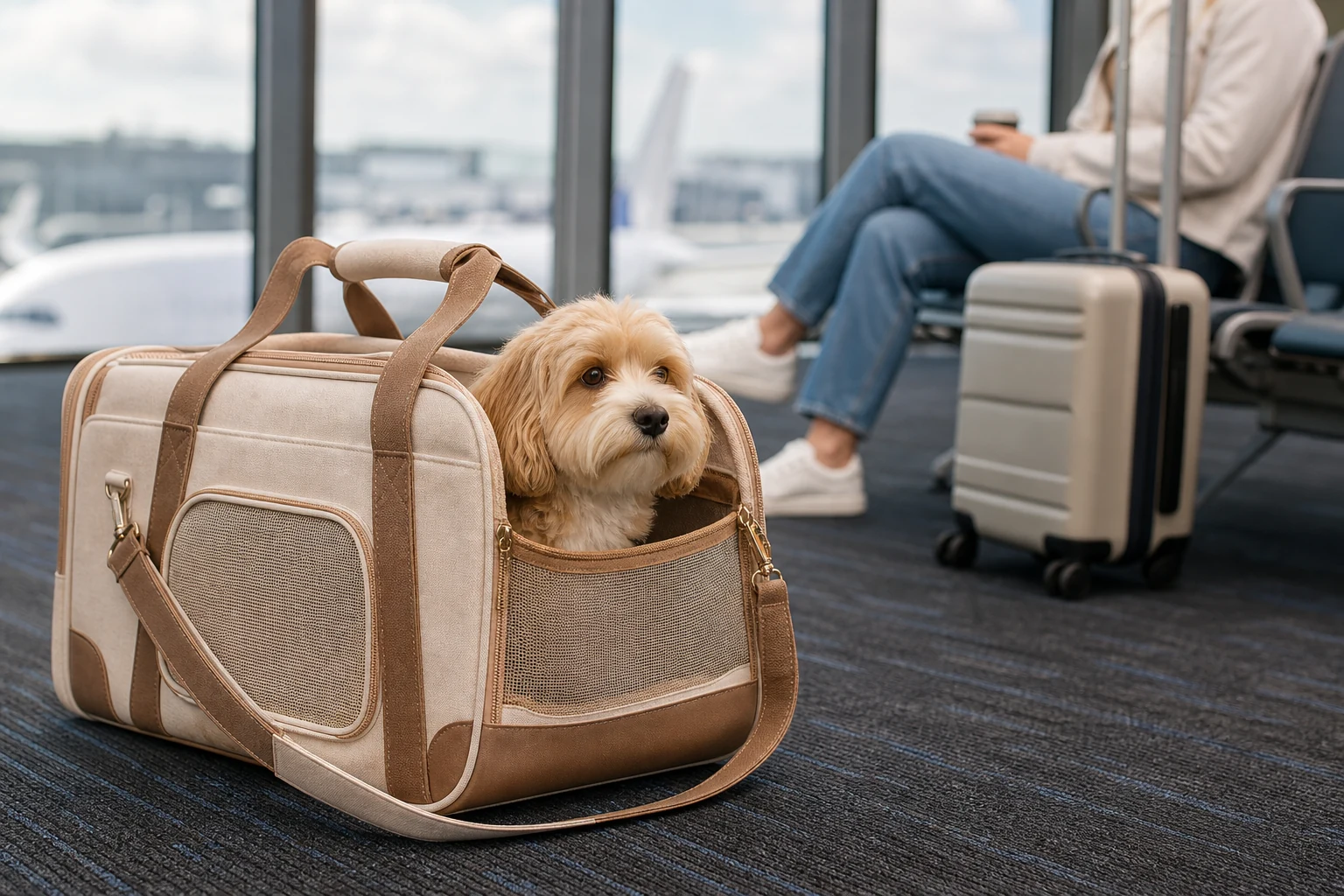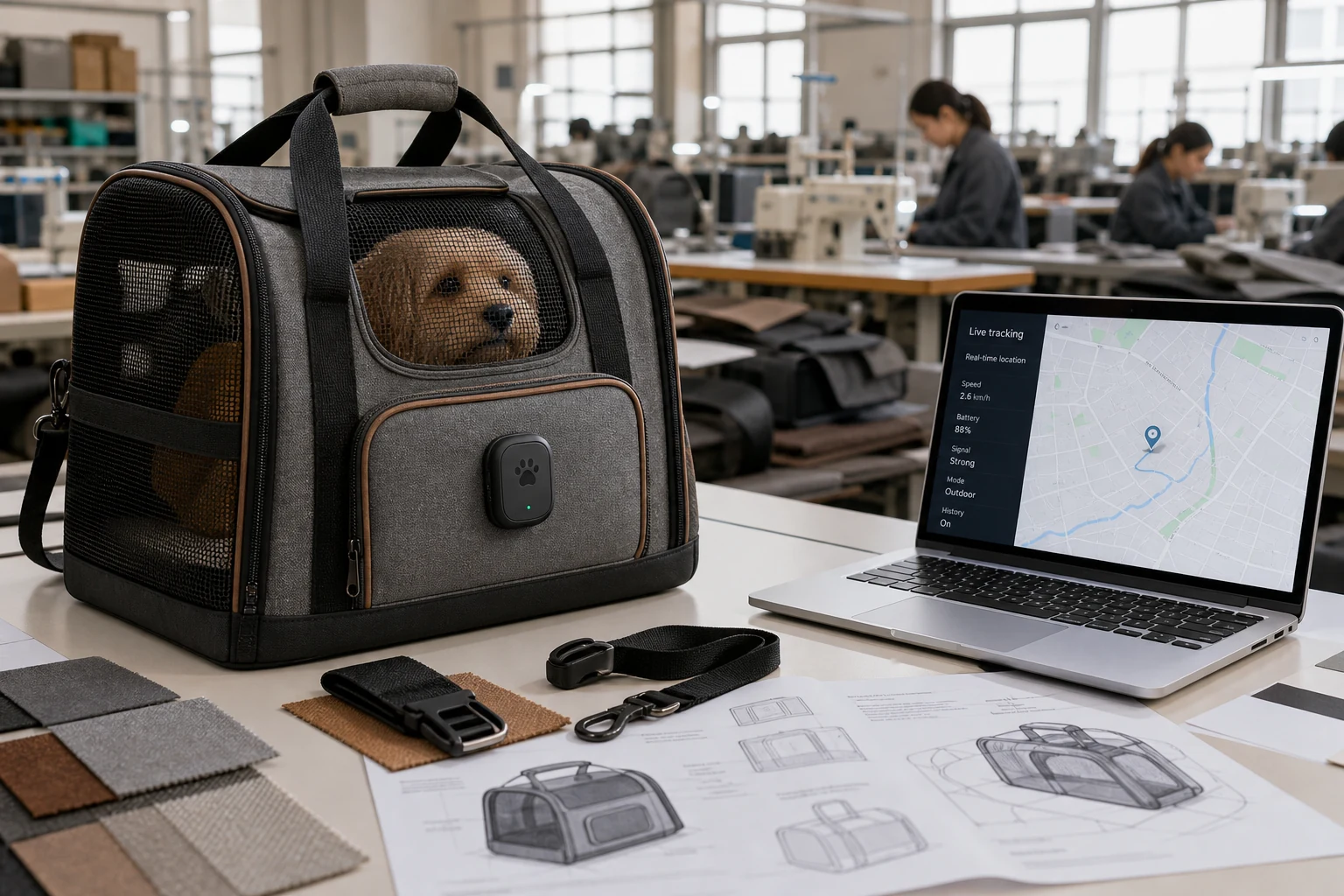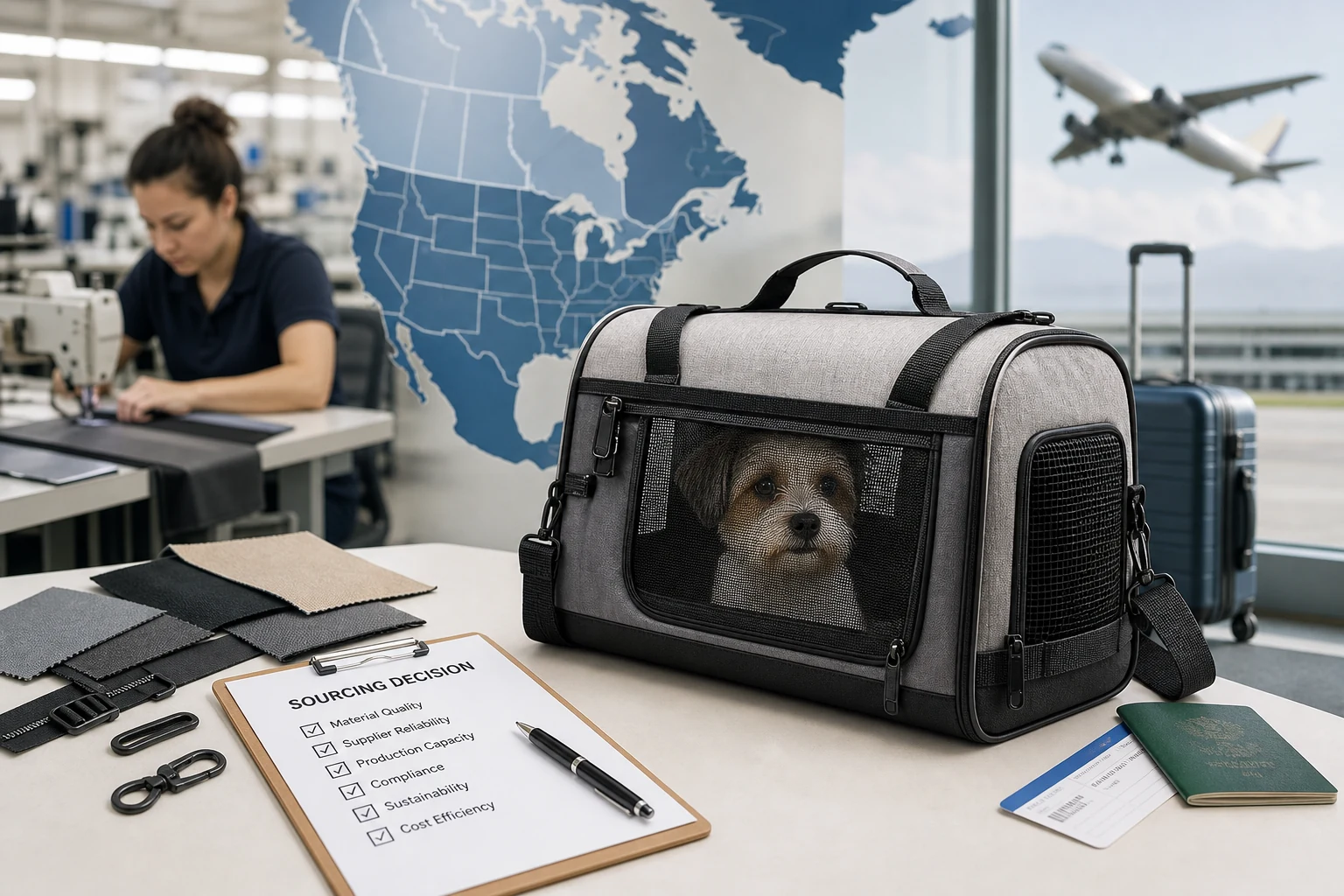
For a 2026 North American pet-carrier line, turn each trend into a specification rather than copying marketplace labels: identify the animal and use case, name the airline or travel route, define ventilation and escape resistance, and document any material or electronics claim. There is no universal IATA cabin size or IATA-certified carrier, so route-specific verification matters more than an "airline approved" badge.
The pet carrier North America market is shifting fast, and B2B buyers who miss the signals risk ordering the wrong inventory. The US pet products market is one of the largest consumer categories, and pet carriers and travel accessories sit among its faster-growing segments. For brands, Amazon sellers, and boutique retailers sourcing overseas, the gap between a bestseller and dead stock usually comes down to one thing: translating what end consumers actually want into accurate specs before a 300-piece minimum order goes into production. What follows is category demand and feature direction; when you are ready to pick a factory, our custom pet carrier manufacturer guide covers the sourcing side.
This guide breaks down five features US pet retailers are asking their wholesale suppliers for right now: which specifications matter, how compliance standards shape what you can legally sell, and how to line up your sourcing so it matches demand through 2026.
Pet Carrier North America Market in 2025–2026 Overview
Three forces are pushing this category at once: the humanization of pets, the post-pandemic normalization of pet travel, and the Amazon FBA private-label boom that adds thousands of new SKUs every quarter. Buyers are no longer satisfied with generic soft-sided carriers. They want defined specs, verified compliance, and differentiated features that justify a higher retail price.
For airline-positioned products, demand translates into route-specific sizing, ventilated panels, secure closures and carrying systems that have to be written into the brief before production. Buyers sourcing from factories in China should separate a market trend from a compliance claim: IATA does not certify carrier models, and the operating airline makes the final acceptance decision.
Trend 1: Route-Specific Airline Specifications Are a Baseline Requirement
The International Air Transport Association publishes the Live Animals Regulations and 2026 Container Requirement 1 for domestic cats and dogs, with state and operator variations. It does not provide one universal cabin dimension or approve a finished carrier. A retail SKU therefore needs a named route and airline matrix rather than an "airline approved" badge.
What This Means for Wholesale Sourcing
Brief the factory on finished internal and external dimensions under the target airline's measurement method, not flat catalog dimensions. Record the animal range, route, airline, padding, pockets, frame and expected under-seat compression in the Product Specification Sheet, then measure the complete sample. Our airline cat-carrier production guide explains how to turn that matrix into a controlled sample without claiming IATA certification.
Trend 2: Four-Way Ventilation Is Replacing Single-Side Mesh Panels
Single-mesh-window carriers are steadily losing shelf space to four-way ventilated designs. US retailers selling to urban professionals with small breeds and cats report that customers name ventilation as the top purchase driver after size. The effect shows up in the listings: products that highlight "4-side mesh" or "360 ventilation" in the title tend to convert better on major marketplaces than those without ventilation descriptors.
Material Specifications for Four-Way Ventilation
Not all mesh is equal. The current spec calls for 1000D nylon mesh with 3 mm × 3 mm apertures, fine enough to prevent paw entrapment while keeping airflow adequate for cabins with low circulation. Polyester mesh with larger apertures (5 mm and up) fails consumer safety expectations. The mesh has to be double-stitched into the main panel, not glued, so it survives the 500-cycle zipper and panel stress tests a serious factory runs during QC. Spell out mesh type, thread count, and attachment method in your OEM brief, or you will burn revision rounds during sampling. Our custom mesh pet carrier builds are made to those apertures as standard.
Trend 3: Orthopedic and Memory Foam Padding Is Commanding Premium Retail Price Points
In the premium segment ($80–$180 retail), interior comfort is increasingly what defines the product. Memory foam or high-density EVA foam floor pads are now expected above $60 MSRP. Carriers with removable, machine-washable memory foam pads tend to generate fewer returns than those with standard polyester-fill padding. For B2B buyers that means a sourcing change: from basic PE board inserts to 8–12 mm memory foam pads with removable washable covers.
How Padding Affects MOQ and Unit Economics
Adding memory foam inserts usually raises the per-unit material cost by $1.80–$3.20 at a 300-piece MOQ. At 1,000 pieces that delta drops to $1.20–$2.40 per unit. The retail premium for "orthopedic" positioning, though, runs $15–$30 over non-padded equivalents. For Amazon FBA sellers the margin math clearly favors the upgrade. When you brief the factory, request foam density specs (minimum 40 kg/m³ for durability) and confirm the removable cover uses a YKK or equivalent rated zipper. Reviews consistently flag pad-cover zippers as a failure point around the 6-month mark.
Trend 4: Shoulder Harness and Anti-Fatigue Carry Systems Are Becoming Standard
Single-handle tote-style carriers are losing share to multi-carry systems. Urban US buyers who carry on subways, through airports, and on trails want padded shoulder straps with real load distribution. Carriers offering three carry modes (top handle plus shoulder strap plus backpack mode) command a 40–55% retail premium over single-handle equivalents in the $50–$100 range. Search interest in "backpack carrier" has grown sharply, and the term now draws strong standalone demand alongside "cat carrier" and "dog carrier" across major marketplaces.
Structural Requirements for Multi-Carry Systems
A working three-way carry system needs reinforced strap anchor points, not just sewn-on D-rings. Specify 20 mm woven nylon webbing rated to 25 kg tensile strength for shoulder straps. Backpack straps need a sternum connector and a minimum 40 mm × 30 mm padded width for comfort at a typical loaded weight of 5–8 kg. Elandmake's OEM work covers custom strap configurations with 3–7 business day sampling, so buyers can validate ergonomic performance before committing to a 15–30 day production run.
Trend 5: Safety Certifications and CPSC Compliance Are Required, Not Optional
The fifth trend is the most compliance-critical: tighter enforcement of US Consumer Product Safety Commission (CPSC) standards for pet accessories sold through major retail channels. Pet carriers are not classified as children's toys, but major retailers and marketplaces now require suppliers to certify that products are free from restricted substances under CPSC regulations, including azo dyes, heavy metals in pigments, and phthalates in PVC components. Factories without BSCI or an equivalent social-compliance audit are being dropped from approved-vendor programs.
What Certification Documentation Buyers Should Require
Before placing an order, ask any factory for three things: a BSCI audit report dated within 24 months, SGS or Bureau Veritas test reports for restricted substances on final material samples, and a written QC protocol describing the inspection stages for each production run. Elandmake holds both BSCI and SGS certification, with full documentation available before sampling. A factory that cannot produce these within 5 business days of inquiry is a compliance risk, and that risk can turn into platform delistings, import holds at US customs, or consumer-facing recalls, all of which cost far more than any saving on unit price.
Pet Carrier North America Trends: Supplier Sourcing Strategy Comparison
Reading the trends is only half the job. The other half is choosing a supply partner who can execute the specs accurately and at an MOQ that fits your business stage. The framework below evaluates suppliers against the five trend-driven requirements above.
| Evaluation Criterion | What to Ask the Factory | Minimum Acceptable Answer | Elandmake Capability |
|---|---|---|---|
| Airline route matrix | Can you build from current CR1 plus named airline limits? | Written dimension and requirement matrix | Buyer and factory confirm before sampling |
| Mesh Specification | What mesh density and attachment method do you use? | 1000D nylon, double-stitched | ✅ Custom mesh specs available |
| Foam Padding | Can you source memory foam at 40 kg/m³ density? | Yes, with density certificate | ✅ Multiple foam density options |
| Multi-Carry System | Can you produce 3-mode carry with rated webbing? | Yes, with tensile test data | ✅ Custom strap configurations |
| BSCI / CPSC Documentation | Can you provide BSCI report and SGS test results? | Yes, within 5 business days | ✅ BSCI & SGS certified |
| MOQ | What is your minimum order quantity? | ≤500 for early-stage brands | ✅ 300 pieces minimum |
| Sample Lead Time | How long for a pre-production sample? | ≤10 business days | ✅ 3–7 business days |
How to Source for Pet Carrier North America Trends at Scale from China
This category moves faster than a traditional 18-month product development cycle. Buyers who want to stay ahead need a sourcing process built for speed and accuracy. The framework below cuts sampling failures and production delays for anyone ordering 300–3,000 units per SKU from Chinese factories.
Start with a detailed Product Specification Sheet (PSS) that covers all five features before you contact a factory. Vague briefs like "I need a soft-sided pet carrier with mesh" produce vague samples and multiple revision rounds. A precise PSS states the animal and route, named airline, finished dimensions, mesh type and attachment, foam specification, strap configuration, required evidence and approval method. Send the same brief to each shortlisted factory and compare the specificity of the response.
Get a pre-production sample before bulk production. At Elandmake the sampling process runs 3–7 days. Use the sample to check the named airline's finished dimensions, mesh openings and obstruction, closure security, base behavior and strap anchors against the buyer-approved protocol. Confirm payment milestones and the production route in the quotation; light customization is generally 15–30 days and heavy customization 20–45 days.
Pick a supplier who can grow with you. A factory that runs 300-piece MOQs today needs to support 2,000-piece runs within 18 months if a product ranks on Amazon. Confirm production capacity and lead-time scaling in the first sourcing conversation, not after your first reorder creates a stockout.
Elandmake: Built for Pet Carrier North America Trend Demand
Elandmake has manufactured pet carriers and custom bags for North American B2B buyers since 2015. Our standard MOQ starts at 300 pieces per style and colorway, with 3–7 day sampling and bulk production of 15–30 days for light customization or 20–45 days for heavy customization. OEM options include route-specific carrier patterns, custom mesh, padding and multi-carry strap configurations; factory audits and product-level evidence are reviewed as separate document scopes.
All Elandmake pet carrier and backpack products are built from traceable materials, including Nylon, Polyester, Oxford Cloth, PU Leather, and Canvas, tested against restricted-substance lists before bulk production begins. Our dog outing bag collection includes multiple base patterns ready for custom branding, color, and feature configuration within the specs this market is asking for.
Ready to source a custom pet carrier aligned with North America demand? Contact Elandmake for a free factory quote — our team responds within 24 hours.